and Universal Truth…

|
Oh God of Light
and Universal Truth… |
|
Remembering Cranbrook, remembering the Class of 1963. It has for years been a work-in-progress. My fondest memories of course are reserved for what I have come to view as the essences of Cranbrook Life, a distinctive and tradition-based Life peculiar to that time and place, still proceeding in continuity with the lives of the Old Boys who had gone before us. It was a Life I was privileged to experience and enjoy in its fullest spectrum, still fundamentally undisturbed from its natural condition borne in the prewar era and culminating in the 1950s, nurtured and carefully preserved by Masters Snyder, Schultz, Bunt, Ricketts, Bates, Coulter, Hoffman, Davis, Coan, Wert, Palmer, Wonnberger, Heavenrich, Wert, Licklider, and of course Rev. Young and Headmaster Hoey.
At times I could stroll through Cranbrook Life, as I did then and often do still in my mind’s eye, savoring images of architecture and seasons, wrought iron windows with small panes of wrinkled glass, polished wood and sunlight spilling over buffed hallways. How many, many times we walked the long hallway of Keppel Gym, staring up in respectful awe at the Old Boys who had gone before, posed majestically in athletic uniform or immortalized on the placards of team captaincies that lined the walls, they never looking at us but we nonetheless absorbing them into our pores day after day, year after year. Would we ever take a place on the wall? Would we ever be elevated to their heights? Would Lower School Boys look up at us in the same reverential manner?
Those of us who started in the Lower School remember some of them - the distance in time being not that great. For me the pinnacle was Larry DeWitt - he was but a portrait on the wall, an unassuming portrait to the casual eye, and I don’t recall ever actually seeing him in person around the School. And in my recollection he was not a dominant three-sport athlete. But I did see him run in a dual meet with perennial state power Birmingham Seaholm in his senior year and what I saw I’ll never forget. Cranbrook athletics has for me always been defined by sweat and tape, running laps, conditioning and cletes. Perhaps this reflects the view of essentially a non-athlete, one who competed by working harder and trying to emulate the other more naturally-gifted Boys. And yet, while we all ran (and ran and ran) and sweated and strained, Larry glided - ‘a natural’ - just ‘opened it up and let it go’, beautiful to behold. That day, as he came around the 220 curve on that antiquated cinder track and blew past the field as if it were in slow motion, he was just gliding - how does he do that? To those of us with no natural gifts, it was awesome - to be in such a place to just ‘let it go’.
With all due respect to Jess Brewer and others who toiled mightily on the cinders, and granting most other sports did not allow such an intimate glimpse, I only saw this phenomenon one other time at Cranbrook, some four years later. It was late in our senior year, one of the last track meets of the year, a relay race - the mile I think, I can’t remember, but clearly a race more for sprinters, and I saw the baton handed off in the backstretch to Elliott Andrews, my faithful companion on the Chapel seating chart for years, never mistaken for a three-sport Boy or, to my recollection, as a sprinter. And I remember asking to myself ‘why is Elliott in this relay - are they shy a guy, or simply allowing him a playful role in his last meet?’ Then it happened - he went into that ‘glide’ thing, the same fluid gait honed over years of cross-country and distance running, with a serenity I have come to associate with those who throughout their lives truly love running, the ‘letting it go’ which, no matter how I might have tried, would always be beyond my reach.
To those of us who were and still are just mechanics (and I dare say damned good mechanics at that), we all still had our moments of quiet, almost unseen and unheard, triumph. Mine included withstanding the challenge of Mr. Palmer when called to stand and translate a passage from Caesar; those three consecutive forehand returns-of-serve down the line winners against Whit Conrad in a practice singles game (alas I didn’t even win the game); and perhaps most of all, after a long, muddy soccer practice in late season, walking across the bridge and up the long wooden planks to the back of the gym, and hearing the symphonic clatter of all those cleats on the cement as we all moved toward the benches outside to remove our shoes, tying the laces and slinging them over our shoulders as many Old Boy warriors had done before us, and into the gym and back past Their portraits ... my cleats, their cleats... our cleats ... at one with the Old Boys.
The Dining Hall, with its monastic ambiance and cavernous sound, was another place of particular importance to me. At luncheon meals (as in the singing of Forty Years On), I was again part of the whole, a recognizable being in a chair of my own, even as a First Former, at a table where sat the two most beguiling actors in the whole Play - waiters and Prefects. I couldn’t wait to be a waiter! They orchestrated the whole meal, all others deferred to them and moved only when they moved. Waiters got second helpings and extra desserts - what on earth could be better? And while there was no chance I’d ever be a Prefect (I knew this intuitively since First Form), the one thing I learned from years in the Dining Hall was that seniors got tea. Not just tea - a cup, a saucer, a tea pot - a signal of absolute distinction to all underclass boys if there ever was one. God, did I hate tea - but after five years in the queue, observing every nuance of the traditional prerogatives of seniority, I’d be damned if I hadn’t requested it every meal - and I did.
Forty years on,
when afar and asunder ...
How well I remember singing that anthem, alongside a few others with a distinctive Martin Luther flavor found in the well-fingered hymnal in Chapel every Tuesday and Thursday morning, from my years as a First Form student in 1957 through the last singing as a senior in 1963. I look back over those six years fondly, perhaps with a touch of arrogance borne of the silent association amongst those dozen or so of us who traveled the whole course together, the true Old Boys from the Lower School who inhabited the basement of the main hall, who wore the Spartan and Athenian reds and blues, whose lives revolved around shooting a bit of stick in the Game Room and were warped in a very special way by Mrs. Brown’s dance class. With those, I retain a common bonding that emanated from the hallowed halls under the watchful eyes of Harry Hoey (and oh, yes, Peter Dawkins); of duckpin bowling in Arlington with Mr. DeWitt’s spring trip just before the hotel caught on fire, late afternoon study halls, being awe-struck by upperclassmen, and the transformation to true manhood achieved from having your neck shaved with hot lather by appointment with Ev Arthurs.
Then there was the peculiar anonymous lot of Day Boys, which I only came to figure out after reflecting back. We would zip in for morning Assembly or Chapel and slide quietly out at the end of the day, only vaguely aware but certainly largely ignorant of the City Beneath and the veritable horde of Boarders who lived there day and night, weekday and weekend, year after year in Page and Marquis, stalking the hallways in the evenings and wreaking calculated and often creative havoc on weekends. For us visiting Day Boys, it was a world unknown, and those who inhabited that World were a different race of beings, a tightly-knit group of survivors, with a language and a lore all their own, gemeinschaft in the truest sense, a secret society unknown, impervious, and impenetrable to visitors like us. I came to realize that for six years I trod the polished corridors, brick walkways and athletic fields of Cranbrook and knew them intimately, and yet only once - once in six years - did I walk into the Commons at Page. To this day I cannot remember which hall is which. I was probably more familiar with Harvey Croze’s studio (few may even remember where that was !) than any of the halls. Needless to say, the lore of the City Beneath was not just foreign to me, it was totally unknown. And it is that lore that lies at the core of reunions, particularly I trust Forty Years On.
Part of the lore involved the rather curious appearance of those little envelopes strewn out on the table each day in the Bookstore, causing a rush of Boys as if rations were being distributed during the war and addressed only by single name - apparently to everyone but me. For years I couldn’t figure out where those envelopes came from and what it meant that I wasn’t getting any. Later on it became something of an intriguing challenge to see if I could join the Important Group of those who got letters, but I could never quite fathom how one gained entre. It was only my senior year when I inexplicably capitulated and actually went to a Senior Tea (I hate tea) at the Headmaster’s House that I actually met a nice Kingswood girl I hadn’t known since the seventh grade. Needless to say, if the life of Boarders was unknown to me, Kingswood was another planet - of which I knew only that they loomed rugs and played field hockey, each in its own way giving me pause. Beyond that, a total mystery. Well, she did sent me few letters and on those occasions at least I was able, with quiet satisfaction, see on the table an envelope with my name on it. Why had this small activity remained such a mystery? Well, it was quite simple once I thought about it - most of the girls I knew were from “the outside”.
And there were other mysteries. What was the United World Federalists? To this day, leafing through the Brook and gazing at the various collections of Boys gathered for group photos, I still wonder about some of these groups. Did we really have a rifle team? Where did it ‘practice’? A debate team? How exactly did one ‘join’ Ergasterion? Where was the magic portal for these intriguing activities? God only knows I may not have been remotely able to contribute to any of them, but their existence, unknown to an Old Boy like me, was quite a mystery. They probably met in the halls, of which I already knew little, in the evenings or on the weekends. The reason I later surmised was that I was a Day Boy and many of these gatherings took place after the end of what for me was the normal school day, for which I arrived (often at the last minute) in the morning for Chapel or Assembly, attended classes and the odd study hall or laboratory period, and ended with sweaty athletic endeavors before showering and departing for home sometime after 5:00 pm. There were occasions when I was asked to identify which activity would I prefer, and naturally I always said ‘art’. I wonder what would have happened if I’d said ‘ah, Ergasterion please’.
Beyond these, single fragments remain vivid: the greenhouse in the science building, making bromine and esters in the chemistry lab, shaved ankles and being tapped by Mr. DeWitt, fresh towels in the shower room, melted open-faced cheese sandwiches in the Dining Hall (my favorite), my old soccer shoes (ghads, seeing what kids wear today is mind-bending), the sting of Barney Crouse’s free kicks, the stream of cool air through the knot opening in the Game Room door, Jim Harlan’s marvelous blue shirts, waxing and buffing floors during Work Period, running the small track above the basketball floor in Keppel Gym, spring trips with the tennis team and my move from an unbeaten first doubles team to a winless season at second singles, Jim Bailey on a cold day being a better soccer goalie than I was after five years, keeping hockey statistics and finding a rather ravenous audience for them amongst the players, Mr. Hoffman’s slides of Baroque churches, my Revolutionary War paper for Mr. Ricketts, scratching out a B- in geometry, making the Honors List in the last quarter of my senior year (better late than never?), Mr. Kenny’s advice that my choice of undergraduate college didn’t matter if I planned to go on, receiving the art medal in the Alumni Court, the mug design that Tibble talked me into (‘aim high’), the illustrated calendars in the main hallway glass case, the ten stitches in my leg days before graduation and Mr. Hoey asking about it as he handed me my diploma, and the Mummer’s Parade in the Dining Hall. And of course the small yellow Report Slip granting me permission to work in the Library instead of attending English class, given to me one day in Second Form by Mr. Hunting for a high grade on a grammar quiz and carefully scrutinized (suspiciously) and then accepted by Mr. (E.) Snyder in the Library. I still have it.
Forty years on,
growing older and older ...
I have many times returned to those walkways, quietly stealing upstairs to the assembly hall, finding my first chair still next to Mr. Bates’ organ and the individual hymnals still in place, casually strolling the quad and the Alumni Court, and finding my name on the new alumni plaques, peering through the window of the original Library, into the Dining Hall and straight to the lower floor where I was a waiter and finding the wait stands still there, over to Jonah to find again the many obscure places where I sat and sketched, and down the familiar stairwell to the bookstore - ‘Can I help you?’ a voice called out - ‘No thanks, just looking around...’, into the Keppel Gym, keeper of the Old Boys and captaincies, and becoming unexpectedly disturbed that the pictures and plaques had been untended, and yes, all the way down to the Lower Fields where many laps had been run. Yes, at least then, the soccer kick board was still there.
And after Cranbrook? Well, as you know, I resisted the traditional paths of the Ivy and near Ivy, and Ann Arbor which was too close for my adverturesome tastes, and instead journeyed out to Boulder, where I had visited on my tour of campuses with my incredibly indulgent parents, and instantly fell in love with the place. There I was to remain - my second home - until released ten years later with a PhD.
My freshman year I started out as a dreamy-eyed pre-med student, playing soccer as a substitute wing halfback on a team that won the league championship and pledging (as most freshmen did) but not in the house where a Cranbrook alum happened to be President, a connection that spurred him to say no more than a brief hello one evening during rush. As happens to most undergraduates, and to the dismay of my father, I ultimately changed my major to history, took a studio art minor and continued to play soccer through my junior year, until my knee gave out. I was never good, but I was persistent and did score a goal in my freshman year (I like to remember this as my being the highest scoring mid-fielder on the team, well, tied for highest scoring ... at one). In the summer following my junior year, I journeyed to Europe on a study-abroad program, touring Eastern Europe and settling for six exhilarating weeks of classes in Vienna, a wonderful experience in many respects that is still deeply embedded in memory - the music, the architecture, the streetcars, the heavy dark Czech beer and the Heuriger new wine, the Durer woodcuts in the Albertina. Though my capability in foreign language, particularly German, was dismal, my interests nonetheless remained in European affairs - history mostly but just then starting to dabble in political science.
I went on to complete my masters degree in public administration, during which I was able to return to Vienna as the assistant to the director and travel through the Soviet Union and again camp in the City (and more importantly travel several times again to the Salzburg Music Festival). It was then that I abandoned any real interest in the foreign service and decided to enter the PhD program in political science, focusing on West European politics and three years later continued my weak effort to bring my halting German up to the usable level by spending a summer at the Goethe Institut outside Cologne. It was during my first year in the PhD program that I inquired of one of my mentors how one might get some financial assistance and he said ‘why not become a TA - it would provide you with a tuition waiver and monthly stipend?’ Of course my immediate reaction was ‘sure’ ... followed by ... ‘incidentally, what’s a TA?’ The bottom line was that I then entered the classroom for the first time as an instructor and discovered my niche.
Incidentally, I ended up writing my dissertation not in West European politics, the subject of my first prospectus, but rather in urban politics (a slight detour I attribute to Wilbur Thompson and in no small part Vienna streetcars) and became something of an ersatz constitutional law specialist within that field. I took my first position at the University of Pittsburgh at Johnstown, a small (2,800 students) undergraduate college in western Pennsylvania where, in the mold of many Cranbrook Masters, I stayed, entrenched, coached the soccer team, took leadership roles in the department and division, mentored students onto graduate and law school, and ultimately served a tour as Vice President for Academic Affairs. I even started channeling our undergraduate students into the Vienna program of which I was an alumnus.
Along the way I married my wife Donna, a local farm girl, in 1976 and several years ago we passed our 25th wedding anniversary with relative ease. No kids, a springer spaniel, two horses - hers a racking and mine a walker, both passing their retired years boarded at a stable and pasture nearby. We’ve done our share of touring around the country, and have a confessed love of aimless walking along Florida beaches. Along the way, I published a few things in urban legal history and in the field of industrial heritage (particularly a book on the development of the street rail industry in the 1880s). And I dabble in photography - devoting my artistic impulses to recording historical sites and urban landscapes mostly - and serve as the official photographer for the Johnstown FolkFest, a music festival held here in the historic district every Labor Day. Several years ago, I decided to gather a bunch of this stuff up and post it on a website, which I’ve done at <www.pitt.edu/~zander>
What we were like
in our work and our play….
I have carefully preserved memories of my several lives, including my Cranbrook Life, in my mind, in my dreams, and in/through my photography. As might be expected, I dutifully returned to Boulder, Vienna, and Cranbrook several times over the intervening years and discovered what we all intuitively know - that while each visit triggers buried images and disturbs the fragile impressions of memory by revealing what has changed, it’s not the same. Those folks - you, me, all of us - have gone on to other lives. And my impressions of Cranbrook are tidily stored just fine where they are - in my mind. With the news of each successive passing of a Master, particularly for me Harry Hoey and Temp Licklider, my mind wanders back and reflects fondly on how they treated me - and each Boy - with genuine interest and unqualified respect. And on occasion, with each copy of the Alumni News, I have mused something on along the lines of ‘I wonder what ever happened to Tom Brown?’ But in the end I always opted to respect the integrity of my fragile memories of Sir Thomas rather than to search him out. The Alumni News has been, as they say, ‘plenty-enough’.
As we have talked about before, it is because of that respect for those memories of my Cranbrook Life that I resist alumni reunions, albeit this time in violation of the implicit admonition of Forty Years On. I expect it will give many former Old Boys, especially Boarders, an incredible opportunity to compare lives and to reconstruct and share old stories. But those would in large part not be my stories; I would be a visitor intruding on their intimate shared memories. I am not being aloof, or arrogant, or even churlish - I simply prefer to leave my memories exactly where they are and not challenge them with ‘updated information’ (imagine a social scientist holding this position!). I remember well social events at which I and my occasional date were similarly visitors on the periphery and I therefore choose, in quiet anonymity and from afar, to simply remain an Old Boy in the whole and undifferentiated sense and not return to take my place on the periphery.
Perhaps on the occasion of that alumni cocktail party at Alban’s, Donna and I will venture down to the Backdoor Café, an unpretentious bistro with a creative chef located in the historic district, and we’ll raise a glass to Cranbrook, to those of us Old Boys in the Class of 1963 and to those who went before us and established the pathways we were privileged to follow.
| With heartfelt regard, Jim Alexander | 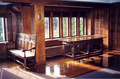
|